

A rigorous experimental framework for detecting protein oligomerization using bioluminescence resonance energy transfer
James JR, Oliveira MI, Carmo AM, Iaboni A, Davis SJ. (2006), Nat Methods. 3, 1001-6
Abstract
Bioluminescence resonance energy transfer (BRET), which relies on nonradiative energy transfer between luciferase-coupled donors and GFP-coupled acceptors, is emerging as a useful tool for analyzing the quaternary structures of cell-surface molecules. Conventional BRET analyses are generally done at maximal expression levels and single acceptor/donor ratios. We show that under these conditions substantial energy transfer arises from random interactions within the membrane. The dependence of BRET efficiency on acceptor/donor ratio at fixed surface density, or expression level at a defined acceptor/donor ratio, can nevertheless be used to correctly distinguish between well-characterized monomeric and oligomeric proteins, including a very weak dimer. The pitfalls associated with the nonrigorous treatment of BRET data are illustrated for the case of G protein-coupled receptors (GPCRs) proposed to form homophilic and/or mixed oligomers on the basis of previous, conventional BRET experiments.
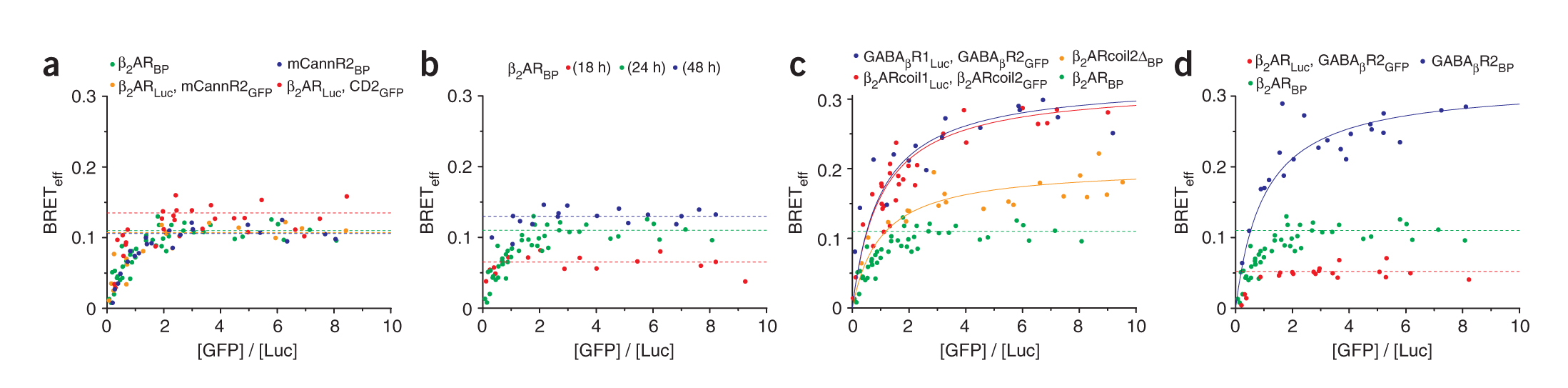
Key figure: Two native class-A GPCRs are monomeric at the cell surface
(a) Both β2AR and mCannR2, expressed separately as BRET pairs or together as a BRET pair, and β2AR and CD2 expressed as a BRET pair, give similar low BRETeff values exhibiting [GFP]/[Luc] ratio independence beyond a [GFP]/[Luc] ratio of 2, with lines representing the best fit to the data, as described in the Figure 3 legend. (b) Variation of the acceptor/donor ratio for β2AR shows no evidence for oligomerization at three different levels of surface expression, with the highest level being ~2 × 10⁶ molecules/cell. (c) BRETeff values for a heterodimerizing class-C GPCR, GABAβR, consisting of GABAβR1 and GABAβR2 subunits, exhibit the hyperbolic relationship with acceptor/donor ratio expected for a dimer, as do BRETeff values obtained for a fusion protein consisting of β2AR and the heterodimerizing coiled-coil domains of the GABAβR complex (β2ARcoil1 and β2ARcoil2). β2ARcoil2Δ is a truncated version of β2ARcoil2 with only half the GABAβR2 coiled-coil. (d) The decrease in interaction when β2AR is expressed as a BRET pair with GABAβR2 is due to the homodimerization of GABAβR2 at the cell surface, which decreases by half the effective density of molecules present.